In case you have been living in a cave, OWS is Occupy Wall Street: a protest movement that arose from an initial call by AdBusters, and is now a world-wide affair with “occupations” springing up in cities across the USA and the rest of the world.
The idea is simple and brilliant:
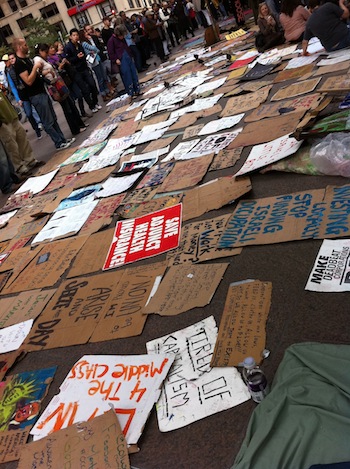
1. Choose a method — occupation — that overcomes the customary weakness of other actions of the powerless such as rallies and marches: politicians, administrators, the police, simply wait them out; let the protestors have their day with marching and speeches, after which the powerful can return to business as usual. Even the term “occupy” upends that relationship.
2. Target the clearest representation (Wall Street)Â of the few who were the primary cause of the economic meltdown of 2008, while also the greatest beneficiaries of the government response to the crisis.
3. Make the identification clear: the most common slogan used by the group is “we are the 99%“. While their sentiments may not be shared by all of the 90+% that took the bulk of the pain and gained little benefit from the Bush-Obama bailouts and half-hearted programs, the material reality is well captured by the slogan. A long overdue challenge, in simple terms, to the Right’s effortless claim to the majority opinion or position.
Due to their resilience, and with the “help” of the inevitable police brutality, this movement has struck a chord and gained popularity and sympathy among the larger public. The response from right-wing organs such as Fox News has been predictable. More unexpectedly, some on the left have issues as well. Here is Jodi Dean:
[T]he language of occupying occupy wall street that I am using suggests that any attempt to hegemonize the space will be a problem for the ‘movement.’ That is, to remain the movement it is (18 days in), it has to resist any and all efforts to channel the message. But that then implies not that the priority is a contestation among people to forge a way ahead but instead that openness and indeterminacy are themselves the goal, that which is to be protected. If that’s the case, then there is something wrong, a kind of built in (self-deceiving?) confusion: the goal is just to keep the occupation going, not to use the occupation to overthrow capitalism or bring down the banks, or redistribute wealth at all. In fact, it’s probably wrong for me to call this confused or self-deceiving: it’s explicit in a number of different statements about democracy and discussion and raising questions. This language is a language of process rather than ends. Or, the process is the end. To the extent that this is the goal, rather than a means of overthrowing capitalism and working toward putting in place a communist solution, then that’s not my revolution.
There is a lot going on in this single paragraph, almost all of which is troublesome. To begin with, Dean gives away the strawman quite explicitly in her very first sentence, with the  accurate qualifier that “the language of occupying occupy wall street” is one that she is using i.e., this is her take on it, and if her take or language leads to some “confusion” or “self-deception” it is not clear who else is to blame here!
And what exactly is a “language of process“, or a “language of ends“? I am pretty sure I don’t know. What is clear however is that Dean wants to lay down the terms on which she will consider Occupy Wall Street “her” revolution: the movement has to share her goal, without question, of a communist solution. Well, okay, that’s her call to make. Why we worry? The trouble I have with Dean’s post is the way she goes about making her point, using all sorts of bad faith hypotheticals, logical leaps, and by playing games with the meaning of words like “process” and “goal”.
One example is Dean’s worry about the presence of Ron Paulites:
To the extent that Occupy Wall Street remains open to and for multiple political persuasions, it is not a left movement at all. Â […] As I understand it, Ron Paul supports an odd notion of free markets; he thinks that individuals make better decisions than groups and that a social safety net damages freedom. If there is space for this view in Occupy Wall Street, then that’s not my revolution. In fact, it seems like a version of the one that hijacked the country in the 70s.
What is “space for this view“, per Dean, and how do the protestors please Dean by purging the movement of such space? Should they chase away Paul leafletters hovering around the periphery? Should they not  listen to them should Paulites attempt to start a discussion? Dean’s own hypothetical extent to which OWS is “open” to alternate “persuasions” or provides “a space” for them, is evidence (“it seems“) that OWS is out to hijack the country. In this analysis, it’s a direct route from hypotheticals (“to the extent that“, “if there is space“) to conclusions.
Another example is the first section quoted above, where Dean condenses all the varied procedures, activities, slogans and positions of OWS to a matter of obsession with “process“. Out of the Brownian flurry of hypotheses bouncing around in her own mind, Dean builds a caricature of a movement — not a movement that is occupying a space to achieve goals (explicitly stated in their statements and placards); not a movement trying to avoid co-option by staying open (while also guarded) to ideas and arguments; but really rather a movement in love with its on machinations and minutiae.
What do we make of the  analysis that people have occupied a park for the fun of the process of being open to Ron Paulites and for the thrill of continuing such occupation into the balmy days of winter, rather than the more probable case that they are using the occupation as a base for protests whose goals are made explicit in their slogans? What could the author possibly mean?
I suspect that to get to the content, you have to work through Dean’s post in a different sequence than top down. It is the Lenin references up front and the political identifications towards the end (“those of us who think of ourselves as communists, Leninists, Trotskyists…“) that provide the necessary backdrop for Dean’s dismissals: “that’s not my revolution” and “Occupy Wall Street … is not a left movement at all“. The contrast to watch for is not the one Dean draws between libertarianism and leftism:
The easiest rough initial cut is between those who begin with an emphasis on equality and those who begin with an emphasis on freedom; another crude cut would distinguish between those who begin from an emphasis on individualism and those who begin from an emphasis on collectivity, solidarity, and a commons.
For surely those actually collected in solidarity in the commons hardly need lecturing (a la Ricard Dawkins: by all means let’s be open-minded, but not so open-minded that our brains drop out) on libertarianism! Dean is of course not lecturing OWS. She is writing to that “those of us“, her people, and the contrast she draws out is really between the ideological commitment of those like her, and the open-ended process of discovery through action employed by OWS. We cannot take seriously the speculation that OWS is some sort of ISO9001 circle jerk. So, when she raises the suspicion that OWS may not be about “overthrowing capitalism and replacing it with a communist solution“, the emphasis is likely on the latter part. The lack of a priori commitment to communism is Dean’s real issue. But there is good news. She is willing to wait for OWS to come around:
For those of us who think of ourselves as communists, Leninists, Trotskyists, Maoists, and socialists, our challenge is finding ways to work within and together with the movement, which can well mean not pushing too quickly for something for which the proper support has not yet been built.
Or of course there is the alternate possibility. As a fellow subscriber on a left mailing list summarised this kind of analysis (using a quote that seems to be widely attributed to Mahatma Gandhi):
There go my people. I must run and catch up with them because I am their leader.
Read the full post and comments »


 Meta
Meta